LuckyElf reviews and complaints
 Available in AU
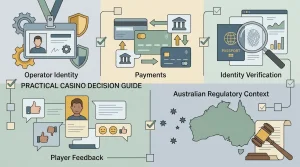
Public feedback about LuckyElf is mixed. Some reviewers describe positive experiences, while complaints also mention verification and withdrawal disputes. That pattern is useful as a signal about topics worth checking, but an individual review is not proof that the same outcome will happen to another player. The strongest way to use complaints is to identify recurring issues, compare them with published rules, and separate documented operator facts from anecdotal claims.
Table of Contents
- What public feedback can tell you
- Why one complaint is not a verdict
- Verification and withdrawals deserve separate checks
- Check whether the reviewer shows evidence
- Australian context matters too
- How to read complaint-resolution sites
- A decision checklist for LuckyElf feedback
- Using LuckyElf feedback as a decision signal
What public feedback can tell you
Reviews can reveal where users repeatedly experience friction. For a casino, the most decision-relevant themes usually involve withdrawals, account verification, bonus interpretation, support responses and account restrictions. If the same topic appears across independent feedback sources, it is a reason to inspect that part of the casino’s terms more closely.
LuckyElf’s public reputation is not one-directional. Available feedback includes positive reports as well as complaints involving verification and withdrawals. The existence of both matters: reducing the record to either “players like it” or “players complain” would discard the mixed nature of the evidence.
Why one complaint is not a verdict
A complaint normally presents one user’s account of a dispute. Important context can be missing, including the exact promotion accepted, KYC status, payment method, transaction history, dates, correspondence and the operator’s response. Even a detailed complaint may establish that a dispute was reported without establishing every allegation inside it.
The reverse is also true for positive reviews. A smooth cashout reported by one player does not guarantee the same timing or verification path for another account. Treat both praise and criticism as observations that can guide further checks, not as universal performance measurements.
| Feedback signal | Useful interpretation | Poor interpretation |
|---|---|---|
| Repeated withdrawal complaints | Review withdrawal rules and verification requirements carefully | Assume every withdrawal will fail |
| Positive cashout reports | Evidence that some users report successful outcomes | Assume payout speed is guaranteed |
| KYC disputes | Prepare for identity checks and keep account details consistent | Assume a reported document request applies to every account |
| Bonus complaints | Check wagering, game and maximum-bet rules before opting in | Assume the headline offer describes all conditions |
Verification and withdrawals deserve separate checks
Complaints that mention a delayed withdrawal and complaints that mention verification can overlap, but they are not identical. Verification can be a condition of account or payment processing, while withdrawal rules can include their own procedures and limits. When reading a dispute, identify which stage actually caused the disagreement.
A useful precaution is to make sure the account name and payment details are consistent, keep requested records available, and avoid assuming a quoted processing time is unconditional. Exact KYC document lists and exact withdrawal timing can change or depend on the case, so current terms and account-specific instructions are more reliable than an old review.
Check whether the reviewer shows evidence
The evidentiary value of a review increases when it includes a clear chronology and non-sensitive supporting material, such as dates of requests and responses. It decreases when the post relies on broad accusations without enough detail to identify what rule or transaction is disputed.
That does not mean dismissing short complaints. It means assigning them the right weight. A pattern of similar reports can justify closer scrutiny even when no single post proves a general problem. Conversely, duplicated or copied reviews should not be counted as independent experiences.
How to read complaint-resolution sites
Third-party complaint platforms can add useful structure by showing whether an operator responded, whether a case was marked resolved, and what evidence each side supplied. Their labels still reflect the platform’s own process. A resolved label does not necessarily mean every user claim was accepted, while an unresolved label does not automatically prove misconduct.
Look past the headline status. Read the chronology, note whether the player stopped responding, whether the operator cited a specific term, and whether the platform independently evaluated evidence. This produces a more defensible reading than counting complaint titles.
A decision checklist for LuckyElf feedback
- Look for recurring themes across more than one independent source.
- Separate first-hand reports from summaries copied by other sites.
- Check the date because terms, ownership disclosures and procedures can change.
- Compare complaints with the casino’s current published rules.
- Do not convert a single positive report into a payout guarantee.
- Do not convert a single complaint into proof of a site-wide practice.
- For licensing and Australian regulation, use the dedicated LuckyElf licence, operator and Australian context guide rather than player reviews.
The main LuckyElf review brings these reputation signals together with the wider product picture. Reviews are most useful when they change what you verify before depositing rather than when they are used as a substitute for verification.
Using LuckyElf feedback as a decision signal
The defensible conclusion from the available feedback is limited but useful: LuckyElf has both positive player reports and complaints involving verification and withdrawals. That makes those areas worth checking carefully, but it does not establish a universal outcome for every account. Use public feedback to identify questions, then answer those questions with current terms, documented correspondence and regulator or operator records where relevant.